Age Appropriate

Warning: This has nothing to do with either smut or sex.

There are some types of knowledge, that, if acquired too soon, you spend a lifetime re-learning. Take your left and right hands, for instance. I’m one of those “other left” people when I’m following or giving directions. I’ll be pointing one way and saying the opposite direction. My husband, who appropriately keeps his eyes on the traffic, has a hair trigger reaction to turning and follows what I say instead of where I’m pointing. We occasionally get lost and frequently miffed. The thing is, when I’ve been speaking French or Arabic (not to him but in other countries and other lives) I never mix up the words for left and right. “A gauche” and I’m pointing with my ring hand. “a-lees’r” and the other hand is pointing. No problem.

I can only think I learned the words too young, before I had learned that the person gesturing in front of me wasn’t a mirror image. I’m sure that is one of the developmental stages a kid goes through quite young. I remember learning to shake hands. The instruction was “Give me your right hand.” My teacher (maybe my Dad – this seems like a dad sort of thing to teach) held out his right hand and I mirrored him. “No, the other hand, your right one.” I learned that to grasp each others right hands my arm would cross my body, rather than shoot directly across the space between us. Mirrors didn’t work that way.

Pronouns are also a tricky thing that way. Jessica was playing with a sharp knife and Mom, in her excitement forgetting to call herself “mommy” says, in an attention grabbing way, “You give that knife to me right now.” The knife quickly goes from Jessica to her. So “me” is Mom and “you” stands for Jessica. Jessica, who was a very early talker, certainly by six months old, might see you eating cookies and demand “Give it to you!” and try to snatch the cookie off your plate.

The penny dropped one afternoon for Mom who was washing dishes. Jessica was playing in the cupboard under the counter. “What are you doing?” said Jessica.

“I’m washing dishes,” said Mom.

“No you are not,” said Jessica. “You are playing with cockroaches.” And she was.

Happily Jessica’s mom was a language teacher. Once the problem was recognized it was a matter of setting up drilling situations to fix it.

With my own daughter it was “object permanence,” that stage in which a child realizes that just because something is out of sight doesn’t mean it is gone forever. That clicked for her when she was about six or seven months old. She had shown no interest in crawling. She would sit up on her own, but rather screech for someone to set her upright. I was both irritated and worried. Suddenly she was whipping back the blanket covering a toy. She was asking for things that were in a different room, saying the name of people who weren’t there. She still wouldn’t crawl, but bounced from room to room on her tush, head up, looking where she was going and moving with serious purpose. Clearly she’d had no reason to crawl until she had somewhere she wanted to go. And crawling? The stairs did that for her. She was fine sliding from step to step on her way down, but she couldn’t get up to her room the same way, so she learned to crawl.

On a grander scale I see the same thing in the classroom. The situation is complicated because you are not dealing with a single child, judging their cognitive stage at the moment. You are dealing with a bunch of kids all at different stages. The teacher’s job is as much to level the playing field by explaining how to get from one stage to another. This is certainly true with helping kids move from concrete to abstract thinkers. With the majority of freshmen, what you see is what you get. Learning to make and recognize inferences is huge. Sherlock Holmes is helpful in this with his astute observations. “I see you come from Bournemouth because your shoes are muddy and your briefcase is sporting a clean stripe where it was rubbing against the luggage carrier in the train.” That sort of thing. Looking at clues like that is nearly concrete; Holmes does an admirable job of connecting the dots. It becomes harder when students need practice in seeing things from someone else’s point of view. Poverty, fear, and ignorance are states they recognize in themselves, but not others. How they react to those characteristics is something else again. They might see Holden Caulfield as a hero for the ages, while an adult might see him as a whiney spoiled brat. And reading “A Separate Peace” is a minefield of missed perceptions. By the same token first person books like “October Sky” and “The Secret Life of Bees” are written in the voices of characters who are aware of their own prejudices, and who have made the leap to being able to see things through another’s eyes.

Should teaching be withheld until the mind of each person is ready to deal with a perceptual shift? I don’t think so, certainly not by the time kids reach high school, and certainly not when kids have finally reached the stage of observing themselves as learners.

Posted in Education, Transitions | Tagged , , , , | Leave a comment

Rafe–Setting Up the Loom

“For goodness sake, go help Fiona deal with her loom and quit plaguing me.” Rafe’s sister stood before the anvil, maul pounding flakes of burned iron off a horse shoe. “Her husband is too poorly, or too drunk, to be of any use. You used to be best friends. Give her a hand. It will do you both good. I swear. I do not know how you’ll last the winter.”

Rafe left her sister’s forge and walked along the street, boots crunching through ice. It had been cold long enough that the water had receded leaving hollow frozen puddles. She should have waited until spring. Rafe had always tried to winter in the north where the sun stayed out and people didn’t have two homes, one above ground, and the other below. Here, in the far south, they said that since the sun pretty much disappeared there was no reason to risk cold as well as darkness.

Her grandmother used to have a quote for everything. This time of year it was, “Hollow puddle, we’ll go cuddle. Underground, safe and sound.”

Rafe used to look forward to that, as she had all her grandmother’s comforting epigrams, until the winter Rafe had contrived to escape top side and first saw the stars dancing in the bands of wavering color. Some said it was angels frolicking with the dead. It had been a real disappointment to learn that there were places in the world you couldn’t see the Angels’ Dance.

“This will be the first winter in I don’t know how long that I’ve spent below ground.” Rafe had met up with Fiona at the weaver’s house. Now, in each hand Rafe carried an end of each of the beam supports for Fiona’s loom.

“You used to hate it when we moved down at the start of winter.” Fiona balanced her ends of the beam supports against her hips. “You used to tell your Ma if the animals could breath cold air all winter, so could you.”

“And I did, too. For all the years I served with Graven’s Guard. It’s worse than living in a cave. And that is bad enough, what with the smoke, and chamber pots, and, you know, smells.”

Rafe looked around. It didn’t, in fact, smell as bad as she remembered. It didn’t smell exactly fresh, but more like walking through one of the unused wings in the Emperor’s palace, like dust, dead flowers, and waxed wood. Rafe couldn’t even smell the smoke from the oil lamps burning from the curved, hangers tipped with the little iron mouse her sister used as a signature. The flames were guttering a bit, as if in a breeze.

“Marlon felt the same,” Fiona told her. “Especially after he grew up hearing you complain. You knew he married Joan, just after you left?”

Rafe nodded and lay her end of the beams on the floor. Jenna had done a good job catching her up on who had gotten married to whom, and whose children visited the forge to flirt.

Rafe started to fit the loom together while Fiona kept talking. Not much had changed since they were kids, Rafe thought. She was still doing the work while Fiona kept a running commentary. “When he started digging the new room for him and Joan, he made what he called a venting pipe and laid it in the floor under the fire-pit. Your sister helped him build it, in fact.”

“I saw the jig at the forge.” Jenna had told her all about the pipe building project. At first they had built a pipe like the one used in the water pump. Then they realized that the just had to keep the earth from caving in, so a half pipe would do. It drew air from above ground and the fire warmed it. In the opposite corner they could use bamboo to suck out the stinky air and send it up.

“He was the talk of the Pig and Toad, let me tell you. The old guard said it was a waste of good metal. ‘New breed of mole, that’s wot we got ‘ere,’ is what they said,” continued Fiona. “Then came the winter and Marlon and Joan all cozy and sweet smelling. That changed their tune, you better believe it.”

They heaved the beams upright and placed the ends in the footing. “Shift it over toward you,” Fiona instructed Rafe. “I need to leave plenty of space for Molly Foal to set up her loom. She’s apprenticing with me this winter. Her ma says she can’t teach her a thing, so she’s asked me to take her in hand. Personally I think she’d be better off working with your sister in the forge, or with her uncle Marlon. But Vi, Molly’s ma, has plans that won’t budge. And then wonders where Molly gets her stubborn streak.

Rafe saw a tall girl, with a strong chin, and a smooth brow approaching with a bundle of rope and shorter loom pieces. She did not look like the kind of girl to give her mother trouble, but more like someone who would welcome you to tea whatever time you showed up.

Fiona pointed to a place near the wall.“We won’t need those until we start warping the looms. Come on. I’ll stake you to a drink of the Pig and Toad has set up in winter quarters. You, too, Molly. Then you’ll set your loom up over there.”

The Pig and Toad had already moved underground to its winter quarters right. Tables and benches were set up near the weavers’ area. Rafe remembered picking up stories from the old guard of their days on whatever front they fought. She, Fiona, and the girl found seats. Fiona made introductions. “Rafe, have you been introduced to Molly?”

“Oh, I know who she is,” Molly started and instantly stopped as Rafe arched an eyebrow in her direction.

“No. I can’t say I’ve had the pleasure.”

“Rafiella, this is Molly Foal, my new apprentice. Molly, this is Rafiella Smith, Jole’s auntie.”

“They call you Ironsong, don’t they? Not Smith. I’ve heard all about you.” Rafe adjusted her first impression of the girl.

“In some circles, yes, they call me Ironsong. But not here.” Rafe sipped her ale, closing the conversation.

Only Molly paid no attention. “I heard a story about you and Grammy Heddle. Was that true?”

The girl would have to get a lot more subtle if she expected Rafe to fall for such a blatant trap. “I have no idea. People tell stories about anything.”

“Well, I heard that you’re not called Ironsong for no reason. I heard that one winter…” Rafe reached out with her fingers and touched the girl’s lips.

Rafe bent close. Her scowl became sincere. “A hunter doesn’t clatter through the forest announcing his presence, at least if she hopes to catch something.”

Molly sat back and did not reply, but neither did she leave. Rafe sat back, too, listening to Fiona catch her up, and did not forget the girl was there.

Posted in Rafe | Tagged , | 2 Comments

Ambiance

I went to a spinning event yesterday, an event that happens in Newport each year. Spinners from all across the state descend on the little school either the first or last weekend of school vacation. This year it was the first weekend, which makes a difference. There was still heat in the building from the last day of classes on Friday. The bathroom was warm. There was no flooding of toilets, sink, or pipes.

This is also, here in Maine, the first weekend of the High School Basketball Tourney. Spinners with high school affiliations need to make a choice. Me? I will always choose spinning over basketball. It is also the weekend before the NETA Spa (sometimes the weekend after, but not this year). This means that the vendors who came to Newport were well stocked.

I rode down with a friend and, despite having made an unplanned stop at Hannaford, we arrived just one minute after the event was scheduled to start. We found our friends and started to make our little spinning circle. It turned out that friends had brought friends and we were a large circle – I think 10 of us in all.

Being in a room with a hundred or more spinners is extraordinary. I’m sure I’m not giving away any secrets. Within minutes I had seen a different way of starting a leader, using conjoined loops rather than trying to catch the new roving into the leader as I normally do. I’m tucking that away for sure. Feet were pumping up and down, the hum of voices was so quiet that you didn’t notice them until someone called for quiet so announcements could be made. Then came the door prizes and cheers as members of different circles won. Next came the Swap, different this year since there was a requirement that it be spinning fiber; there were no books, no cheesy bags of unwanted acrylic yarn, and nothing the giver would spin themselves. For the first year in ten, I had brought nothing to trade. That, alone, changed my outlook. Then, at 2:30, came the “last call for vendors.” There was a flurry of last minute purchases. I thought about more of Pogo’s roving, but remembered that I still had a broad selection of her offerings in two ounce bundles, waiting to become my “Sunrise, Sunset Sweater.”

I reconnected with a cherished friend I hadn’t seen for two years. It was wonderful wandering around the vendors, feeling the wool and catching up. We encourage each other to try new things and take risks. She bought some wonderfully golden mohair. Spun it was like walking through an oak forest. I bought this (left)Sunshine Roving Together from a new vendor who is part of a community fiber cooperative. Very light and airy. A pound was huge. Here is my plan. I’m going to separate the colors (right). Spin them thin and Navajo-ply. My goal is to get a giant  gradient lace spun yarn that I will then knit into a Sunshine Shawl.  Sunshine Roving SplitTo get the proper effect I’ll need to bind off the edging rather than use an applied edging as my bind off strategy. But that will be OK. What I have in mind will be reminiscent of a giant yellow mandala I painted on the infirmary wall at the University of Rhode Island.

Here is where the ambiance really comes in. Everyone was branching out, relaxing into the process of spinning. One spinner, who normally spins natural fiber from her own sheep, added the bling of Firestar to a sample. Another (my riding friend) spun a color that reminded me of the sun drenched Caribbean. The spinner to my right had bought what looked like rusty roving, but spun it took on the character of the heart of a volcano. Behind me a lady had brought an electric spinner and did a constant business with people stopping by to ask questions and take a gander at something not many of us had seen.

There were people I never talk to, but am always happy to see. I recognized some by their sweaters – one a beautiful cable montage of blue panels joined by dark blue single cables, socks – Fair Isle shown off under skirts and Birkenstocks, and shawl – from the simple Tasha Tudor to the complex lace that I tend to knit. The lady with the tulip painted wheel was there, as were a pair that spun on dark, castle style wheels.

In the middle of winter I was in the midst of heat and friendship. It was a sunshiny drive there and back home. The snowstorm just barely starting as I drove into my dooryard.

Posted in Spinning | Tagged , , , , | Leave a comment

If it’s the growing season why isn’t it called “winter”?

In 2016 the Summer Olympics will be held in Rio de Janeiro, Brazil. I looked that up. Wikipedia notes that this is the second time the Summer Olympics will be in the host country’s winter. An interesting paradox that. And, of course, it got me thinking. I have a FaceBook friend in Australia who has been reporting on record heat waves as I’ve been reporting on sub-zero (that is Fahrenheit) weather. And, yes, I get that seasonal shift, and tangentially weather, is not the same around the world. But what of the power of naming things, like seasons, or geographic orientations, by one culture, to be imposed on another; to insist on a geo- or ethno-centric meaning?

I got my introduction to this living in Kenya as an eight year old. I learned that there was the Rainy Season, the Dry Season, and two Seasons of Short Rains that represent the ramping up and petering out of the Rainy Season. There was mud to contend with during the Rainy Season, and people talked of bandits “taking advantage” (although my family never encountered anything like that). There was going to bed with the sound of rain on our corrugated tin roof, and walking to school in the rain. There was watching people walk sedately to and from church services, all dressed in white, and letting the warm rain fall down without paying any attention to it. Only white people carried umbrellas and worried about getting wet. I’m afraid I didn’t have much sense of the growing season, but was vaguely aware of young plants in the garden, my mother buying her own lettuces, and watching as pineapples and bananas matured.

There were holiday-like events. We celebrated Guy Fawkes day, Independence Day (twice, once for Kenya and once for the US), Thanksgiving, religious holidays like Easter and Christmas, and Boxing Day. For me, because I was eight, the important seasonal change was a result of school. We had the months of April, August, and December off. The family, or sometimes just my parents, would head for someplace interesting and somewhat educational, the choice, I suppose, driven by the local weather. Nairobi was a December destination with dental visits and shoe shopping balanced by visiting the orphaned animals preserve and book stores.

The next time I even considered this, with a better idea of the cultural ramifications of how people designated seasons, I was in the Peace Corps serving in Morocco. I don’t even remember the reading we were doing, but somehow the idea of winter came up. I was describing skiing, comparing winter in the States to Winter in Morocco. I mentioned “feet of snow.” One student asked when we planted our crops, then, with all that snow. In the spring.

“That’s crazy!” someone said. “Spring is harvest time. If you don’t harvest in the spring, the summer drought will kill your crops.”

I explained that for us, the growing season was summer. We typically had rain, or were able to irrigate. During the winter the hard freeze, at least in the north of the States, would kill most crops. I talked about states where it was common to have two harvests, where crop rotation was a practical way of refurbishing the soil. They thought I was crazy. That I was blowing smoke. That, unfortunately, they had gotten a dud teacher who might speak English like a native, but was clueless about important things like the interaction between agriculture, weather, and seasons. I realized that I had misunderstood how certain words were translated. I had assumed that because the months, more or less, matched up with how I understood the seasons, the words for those seasons matched as well. I was twenty-three and just beginning to understand what it meant to recognize that there were time it was necessary to shift my paradigm.

The capstone of this musing is the recollection of an episode (season 2; episode 16) from West Wing. It’s the Big Block of Cheese episode in which CJ is shown the Peter’s Projection of Earth which has Africa, South America, and Australia on the top of the globe and North America, Europe, and Asia on the bottom. It reminds me that history, and apparently maps, are written by the victors. It reminds me of how home-centric we all tend to be. CJ is quite uncomfortable at the flipping of her world.

For me this map orientation discomfort came in Morocco. The country is bounded by both the Atlantic Ocean and the Mediterranean. I never had a problem going north to the Med. But, whenever I headed to Rabat, a trip that had the rising sun to my back and the setting sun blazing in my eyes, I could never shake the sense that I was really traveling eastward. I knew what the map said. I knew what the sun said. My New England bred gut, however, insisted that the Atlantic was in the east. For seven years I couldn’t shake this feeling.

How provincial are we really, at heart? I like to think we are getting a bit more global than the missionaries that dressed for a New England weather by the calendar even in Hawaii (James Michener). But then what of the Summer Olympics?

Posted in Transitions | Tagged , , , , | Leave a comment

Leaving Maine

This is in homage to my dad, whose name was most definitely not ‘Vance.’ It takes place at the former Dow Air Force Base, now Bangor International Airport. Dow-afb

The first time Vance left Maine he hadn’t been here for long. He had arrived in June of 1968, surprised to see snow lurking in the deep woods. He shook plenty of hands in Orono at a meet and greet for a job at the college. He was moving on up and breaking ranks to boot, the first man in the Department of Human Resources (no longer Home Economics). His host dropped him at the airport.

Vance waited, balanced on a folding chair at one end of the giant Quonset hut that served as Bangor Airport’s public terminal, three hours early for his flight. A Bangor Daily News slowly yielded up some sense of what his new home would be like. His family would love it. It was a day filled with potential.

A shadow fell across his paper and a woman said “Do you need to stay here or would you like to get out early?”

“Early is good.”

“Follow me.” And he did.

They trotted across the tar, she with her clipboard and he with his overnight bag. Bang bang bang, she whaled against the door with her fist. “I got another one for you, Jake. Goes about 185. One bag.” There was grumbling inside. The door creaked open and a step ladder dropped onto the tar. Vance climbed in.

The last time Vance left Maine it was June again. Now Professor Emeritus, he was heading off for a 4 month stint in the Caribbean, teaching child development. Vance hadn’t traveled on his own in years. He cleared security. Never again, he thought. He’d stay home after this. Any thing could happen. He sat in the molded plastic seat, watching the line of accordion walkways that muckled onto the planes. There wouldn’t be any earlier flights today.

Posted in Uncategorized | Leave a comment

Rafe–Frozen River

Jole poked the end of his gaff into the snow that now banked the river. This was his first year doing a man’s job. Old Farley had drilled pilot holes and declared the river frozen enough to start gathering ice. The cutters were out with their blades. Drovers had their sledges lined with hay and sawdust, ready to haul the blocks into the ice house.

Jole moved out onto the surface of the river. His job would be to snag the chunks as they flew into the air, pushed up by the water that filled in the gap as the blocks were released from the mass. “Hey! Watch out you kids!” Jole swung his gaff toward a group of kid who were creeping toward the men. He had, of course, done the same thing when he was a kid, seeing how close to the cut he could get. It was a dare that all kids did. But last year Mick Jakes’ little brother hadn’t dodged in time and that memory stuck.

The first knife was slid into the hole in the middle of the river. The serrated edge cut smoothly, parallel to the bank. The second side, opposite the first was finished. A team of men cut into the ice in a line perpendicular to the bank. They would finish together. Jole moved into position, his gaff ready. Mick was opposite him. They would pull the flying block forward as the cutters ducked an slid out of the way. Hale and Mose, at the cut in the middle of the river, would pull the ice forward, keeping pace with Jole and Mick. They braced to catch the ice.

When the sides of the hole were more than half finished there was a sound like the screel of the low strings on a violin played out of harmony. The ice cracked neatly along the marked lines and dropped out of sight. Thunk. Jole exchanged a glance with Mick, who shrugged. Where was the water?

The crowd on the bank murmured on the bank and Jole turned, locking eyes with his Auntie Rafe. Her scowl as she stalked onto the ice made her look less auntie-like than ever.

Jole skated on his feet with Mick and the rest of the men, up to the edge of the hole. Children dashed ahead. Inchy Foal’s sister slipped over the edge without a splash. There was a hollow sound as she seemed to hit bottom. They could hear the ice block rocking. The cutters gasped.

“There’s dead fish down here!” called Inchy Foal’s sister. “Froze solid.” Three fish, one after the other, came flying out of the hole to clunk on the ice. “And guess where Mare Fisher’s headpiece ended up!” A wedding crown came arching out of the hole and clunked on the ice as well. There at the bottom of the river, high and dry but well below the bottom of the ice, standing on the freshly cut block, was Inchy Foal’s sister. A fish, sticking out like flags, in each hand. “There’s all kinds of stuff down here,” she hollered.

A pool of bright light surrounded the girl. Mottled shadows surrounded her as the sun bounced off thickened places in the ice. Toward the ford the river floor sloped up, nearly touching the bottom of the ice. In the other direction the floor sank away into the ice-imposed dusk.

Posted in Rafe | Tagged , | Leave a comment

The Dreaded CCSS

I have just finished reading Diane Ravitch’s monologue against the Common Core standards. (I’ve linked to the English Language Arts section because I am, or was, and English teacher.) As always when I read something, a bunch of stuff comes to mind.

First – I am impressed that Ravitch embodies the concept that there is no public stance that can’t be retooled. In the Washington Post, February 26, 2010, and coinciding with the publication of a brand new book, the reviewer writes, “Diane Ravitch, an education historian, now renounces many of the market-oriented policies she promoted as a former federal education official with close ties to Democrats and Republicans.” She was excused at that time as being brave enough to say when she was wrong. While I recognize my suspicion of her motives, the sincerity of her comments, as something of an ad hominem fallacy, Ravitch is guilty of bandwagoning. In the Post article from January 18, 2014 there is the transcript of a speech in which she comes out against the Common Core, not so much because it is trying to run a school like a business (her 2010 revisionist stance), but because it is associated with testing businesses like Pearson. So, if you’ll excuse me, I’d rather think this through myself.

Second – Teaching to the test? Nope. I hold with Janet Allen’s comment that if you teach well, teach skills that kids need to know in order to become good readers and active learners, the tests would take care of themselves. (My source here is a workshop I attended in the summer of 2001.) In my experience, my goals in teaching kids how to think critically, and use evidence to support their arguments – even if the argument is just “This is a cool place; here’s why.” – is above the normal standardized test scenario. The world is an infinite variety of colors, tones, and textures that can be honored, even in a classroom, while teaching to the test forces an unnaturally black and white world on all concerned.

When is “teaching to the test” useful? Vocabulary. But not the kind of vocabulary where you learn Latin or Greek roots (although this kind of awareness of language might be part of it). Kids learn the buzz words that test makers use. Jim Burke’s Academic Vocabulary is super for this. Using the words in context is far more important, however, than just learning it by rote. They also need to know the vocabulary of how we talk about the tools we use, so words like “ellipsis” and “metaphor” and even (maybe) “zeugma.” And I’m big on “analogy.” For other subjects, more content driven, these English-y concepts and skills are the perfect tools for discussing the causes of historic events, or the processes involved in distinguishing different biological or chemical interactions.

Third – Teachers, as do students, need to get back into the habit of thinking for themselves. I know that we have faced a reign of terror with the NCLB assault. But do we really, honestly, want to go to a prescribed system of classroom work? With the list of exemplars and models, we get into the issue, not of teaching to the test, but of teaching a uniform rostrum of work. These accompany the Common Core as explanation, but are not, as I understand it, the Standards themselves, rather just examples. Certainly it is easier for administrators to deal a prescribed system. Certainly it means that the teachers themselves can be much more plug ‘n’ play. (This further brings to mind the scene in “Catch 22” when one of the characters considers applying stationing rods through the hips and hands of soldiers, forcing their arms to remain in sync with their march step. I digress.) But we know that the best learning takes place when teachers and students are both excited and engaged. If students need to learn a skill, let them practice it using topics that engage them. Let teachers present that skill using topics that interest them. Teachers get to share the topics of their own passion, and students get the lure of knowing they will be able to get to their own ideas and demonstrate competency of newly learned skills. I have been to too many workshops where content is dictated.

“What books do you teach?” is a question that makes me cringe. Frankly, I’ve never taught books. I’ve used books to teach reading, presentation, and research skills. I’ve used them to teach reflection and analysis. But, with rare exceptions, do I find books, or stories, or articles, so important that I want to share the content of those. One of those exceptions is Catherine Ryan Hyde’s “Pay It Forward”; everyone should understand and practice that concept – but I recognize that as a personal philosophy, one that a local community might espouse, but not necessarily a Federal Government (although it would be nice).  Yes, there are books I love and use as exemplars for the skills and strategies I am addressing with a class, but I consider my audience in choosing which ones I will use. I think of their interests, their reading levels, and the prior knowledge they bring to the party. I want them on board, not an entrenched enemy. I certainly don’t want to be wed to the “Federalist Papers,” or “Moby Dick,” or “Little Women,” or “Hamlet” just because they are classics and on someone else’s list. I read them once (OK, not more than 5 chapters of “Moby Dick”) and it was good for me. I can justify a good case of the chicken pox as a good exercise of my immune system, but I don’t want to go through it on a yearly basis. I believe we want kids to take the skills they learn and be able to apply them to a variety of situations.

Fourth – Let’s separate the list of the Common Core elements from the rather lengthy narrative about how it should be assessed, anchor papers, and exemplar reading material. The roster of skills, whether math or ELA, is far more descriptive than prescriptive. ELA-CC describes the primary three modes of communication: reading, writing, oral. Math looks at numbers, manipulation, and problem solving in a variety of modes. The two are tied together using logic and situational analysis. All these can be applied to any content area. There should be this sort of cross pollination. I make equations of English concepts; a math teacher uses language to describe problems. Yes, this is overly simplified; yet the potential for a textured, colorful world view is here. Don’t we go about the world, in our communities, encountering problems, figuring them out and then sharing our solutions? Isn’t this how we got light bulbs, cars, and dynamite?

I bring in dynamite on purpose. It is the heart of this analogy: just like dynamite, the Common Core can be used to clear space for productive thought, or it can destroy the fabric of education. We know that only the depraved would set off a explosive in a crowded stadium. Well meaning people also know that some well placed explosive can clear away a derelict building with a minimum of fuss and leave the space for something new, and more useful to be built.

Posted in Education | Tagged , , | Leave a comment

The Power of Place

When I started to drive for the ambulance service, and was heading for the MDI Hospital, I was instructed to radio ahead when I turned onto Eagle Lake Road letting them know that I had just rounded “RA Corner.” “Don’t call it Raggedy Ass Corner, even though everybody does,” said my instructor. “You’re not allowed to say “ass” on the public airwaves.” OK,  I thought.

Where the heck did that name come from? Was it the winding hilly road that formed a T with Eagle Lake Road? Was it the fact that there was no way to really take the corner in an elegant manner regardless of which way you intended to turn? Was it the old slouchy junk-ridden barn that used to stand on the corner? It is a purely local name, not found on any map of the area, but occasionally referred to in descriptions of the MDI Marathon route. Like so many things, it’s gotten me thinking about how we identify locals.

In Westport, Mass. there was a road pronounced “Schlotty Wite Road.” I had grown up hearing about people who lived on that road, some without power or plumbing, who were “no better than they should be.” Years later on a tour to help us remember where we came from, our parents chanced to drive down that road reminiscing about some of the famous skinflints who had lived there. Later on a grocery run for my grandparents there was talk about the new development off “Charlotte White Rd.” Private comments, later in the car, let me know that my folks didn’t think too much of that sort of newcomer, who just moved in and voted in changes in zoning “like nobody’s business.” “How do you know he was a newcomer?” I asked. “Well, he didn’t know how to pronounce the name of the road he lived on.” “I would never have guessed that ‘Schlotty Wite’ and ‘Charlotte White’ were the same thing.” They looked at me sadly, as if I had lost my way. The irony of this is that my folks had moved us to Maine, where the sense of being from “away” is even more restrictive than it ever was in Westport.

In Orono there is “Fudgies” which is now known as “The Big Apple.” In Somesville there is “On The Run” which used to be “The One Stop” which used to be “Fernalds” which moved from “the place Fernald’s used to be” at the head of an inlet off Somes Sound, which became “Port-in-a-Storm” bookstore, which is now some kind of antique artsy place with no visible name. These are all places where one business has flowed into another. There are others where the entire purpose has changed. In one town there is “the skating rink” which used to be “the opera house” and now houses an IGA. Some places actually give a nod to their former iteration, like the School House Apartments. I was confused, when I was in Jonesport, by places referred to as “Nellie’s” or “Ab’s” that had no outward label that hinted at the connection. These places, just like Fernald’s are more important for their founders than locations. It certainly made me understand that I was truly from away.

A couple of weeks ago I found myself caught in this bind of being local or not. After a two year hiatus, I have moved back to the town where I married, had kids, and established two fairly different careers. I am known here. During our sojourn Downeast, I was particularly aware of the ties I had to MDI and Southwest Harbor. My spinning group is still centered here. I know and am recognized when I go into the post office. Kids I taught in school are now managers at local stores. I see parents from my own children’s high school classes and we trade news about how and what our kids are doing. It took me eight or ten years to build this sense of community, and another dozen to bask quietly in its comfort. There is none of that, yet, Downeast.

I remained mindful of the fact that I am from away; I am not, to paraphrase Tim Samples, that cat who believes I’m a biscuit just because I’ve spent time in the oven. Still and all, I feel a sense of belonging. So when I walked into the library to enquire about restarting the Wednesday night knitting group, I was a little surprised to be met with a definite who-are-you-anyway attitude. Not by the people who had seen me, as a young mother, shush my kids; or the ones who remembered my $55 library fine; or the ones who I had known before they were married with kids of their own. But I found myself saying “You may not know me, but I’ve only been gone two years and really do consider myself local.”

Posted in Transitions | Tagged , , | 3 Comments

A Different Homecoming

In the words of Monty Python, “Now for something completely different.”

Rafe stood on the bluff, hand resting on the well carved oak. How many years had it been? Twenty-five? Twenty-seven? She pulled out her knife and began cleaning out the grooves that made up her own mark on the tree.

“Waaaaaaa!” The screaming face bowled her over. She grabbed the drawn fist and flipped the lad neatly, pinning him down with a knee to his hip and an arm across his throat.

“What do you think you are doing?” Rafe demanded. She narrowed her eyes to focus on the too close face. She could see he was not quite a boy. He had enough heft to knock her down, after all. But he was dressed like a minstrel, for god’s-sake. And he had a flute still clutched in the hand that was trying to punch her in the head.

“What do you think you were doing, yourself? That is my Aunty’s mark. You got no business!”

Rafe squinted at her captive, drawing her head back to get a better view of his face. Twin creases shot up from the base of his nose between two bushy eyebrows. His mouth, however, would have been her own if Wardren’s axe had not realigned her face at the Battle of Mardge. Bloody, swampy place.

“Hey!” The lad’s voice recalled her to the present. “I asked you what you thought you were doing with my Aunty’s mark.”

“You’ve got balls, boy, that’s for sure. And your mother’s nose and your father’s eyebrows.” That clearly brought him up short. “Gods! Jenna was just courting the last time I was here. And look at you! All grown up.” Rafe released him and helped him to his feet. “What’s your name, boy?”

He stared at her and scowled, deepening his brow crease. It would have been more effective if the hair on either side hadn’t wriggled like woolly caterpillars. “You can’t be my Aunty. She’s a soldier and probably dead.”

“Jenna told you that, did she?”

“Everybody says so. Even the old warriors at the pub.”

“Take a look, lad. And use your brain. I didn’t choke you so hard that you should be addled.” Rafe knew what he was see. She had cleaned up at the inn at Wingate and had only been on the road a day since then. Her nearly white hair was tightly braided and held to the back of her neck in a gold clip. Her hazel and gold eyes, a nose that listed to the right before being pulled left where the nostril had been slit when an enemy had torn her nose ring out. A faint scar leading from her right hear turned her natural scowl into almost a half smile. The leather jerkin supported a knife belt and the strap of her scabbard; the hasp of her sword looming over her right shoulder. Scarred and tattooed arms crossed in front of her chest. She was wearing the riding pants favored by her troop, leather fastened at the waist, knee, and ankle, covering inner legs, seat, and groin, revealed shade colored cotton beneath. Heal-less boots laced below her knees.

“Jenna?” The boy’s eyebrow quirked up, just like his dad’s. “Oh, Ma! But you’re not, are you? Dead? You’re Aunty Rafe.”

“Yes, boy, I am. Although I admit it sounds odd.” Rafe turned back to the tree and started cleaning out her mark. “And your name?”

“They call you ‘Ironsong’.”

“Your name.”

“Wilf. After my grandfather. Did you know him?”
“Of course, I knew him. How could I be your aunt and not know my own father. Are you dim boy? I thought you looked brighter than that.”

Posted in Rafe | Tagged , | 1 Comment

Mobius Madness

Here is a “How To” I sent to a BadCat’s Into Infinity knit along. At the end are some of the completed scarves that make the cast on portions completed. I’ve also improved my photo editing skills, so the arrows and in picture labels are better looking (I think).

Yet another mobius cast on

There is another type of mobius cast on that I have used. It also results in a center-out mobius scarf / shawl, rather than knitting a strip and doing the half hitch before joining the ends.

clip_image002I use the “simple” half hitch cast on for half the number of stitches. (This ends up being the number of stitches needed for the diameter of the project.)

Mobius 02 - laid out

I make sure they are all straight on the needle. This is laid out as I cast on. The working yarn is labeled to the left and the bump I will knit into is on the right. I’ll flip this 180 degrees before starting.

Mobius 03 - knit through bottom copy

Twist the first stitch cast on – the one farthest from the working yarn – 180 degrees. This presents the bump between stitches at the top of the needle. The left and right ends are also reversed Inserting the needle tip with the working yarn between the first and second stitches. The needle will go between the bump and the cable in the place indicated by the arrow.

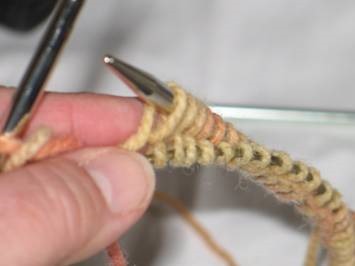
clip_image008This is the backside of the first 4 stitches. The original cast on is around the cable, and the new stitches are on the needle. The darker orange stitches are the first ones cast on.

clip_image010 I knit the bump and continue on around until I arrive at the beginning. You’ll notice that the cable overlaps near the ball and again near the right edge of the picture.


clip_image012When knitting the first half of the next round (up until now you have been casting on) you will have to untwist the stitches. You can see the stitch twisted as it is lying on the needle. You need to lift it off knit-wise and replace it so the front leg is loose and open.

clip_image014 I untwist the stitches with a spare needle.

clip_image016


You can see that the replaced stitch is pleasantly loose, easy to knit, and not going to yield a massively twisted stitch.


clip_image018

I generally untwist about 20 stitches at a time and then knit off the spare double pointed needle.

This was presented in a Knitter’s Magazine YEARS ago. The toroidalsnark.net mentions the Winter 1991 with Meg Swanson and Rita Buchanan as the authors – and that sounds right. An advantage is that you can’t do anything but a half twist with this method – the disadvantage is that you do have to untwist half your stitches on the first real round.

Some examples of pieces using this cast on method.

IMG_2260 copy

I suppose the number of cast on stitches could be described as N+1/2 N where N is your pattern repeat (in this case 4). I used that for this scarf with ribbing down the center. Like BadCat’s Driftwood scarf (shown below) this one is designed to flop over, so there is, paradoxically, a “right” side and a “wrong” of a mono-sided plane. The arrows indicate the cast on row. You can see that there is the same kind of job you would get from using a provisional cast on and then picking up and knitting in the opposite direction. Below you will see two pictures – one of the scarf pinned out, and one folded over for wearing.

Alpaca 3-tone mobius Alpaca 3-tone as worn


This is made of Frogtree Alpaca. The ribbing merges into a cat’s paw stitch, followed by a little diamond leaf design and finally an arch-lattice effect that I charted.

DriftwoodMobius - Cast on DriftwoodHere are a couple of pictures of the Driftwood scarf / necklace. I’ve used gold beads. The yarn is Caper, a merino, cashmere, nylon blend dyed by String Theory. It is actually quite luscious and the nylon is undetectable (yes I’m a yarn snob). I’ve marked the cast on row. You can also see the scarf blocking.

Last, someone on the list mentioned a triangle mobius, which, of course, I had to try. I found this page and learned, to my surprise, that the single plane aspect of a mobius is maintained as long as there are an odd number of half twists involved. I twisted this scarf 5 times – or 2.5 rotations – before picking up the stitches for the other edge of the scarf. It turned out that this gives 3 corners instead of the 5 I expected. That suggests that if .5 yields 1 corner (the traditional mobius) and 2.5 yields 3 corners, in order to get the 5 I wanted, giving me a pentagon, I would need to twist the initial cast on 4.5 times. I suspect this would be too bunchy.

Two and a half twistsWhat you see here is a K5, P5 checkerboard pattern with an initial cast on of 205 stitches to yield an eventual 410 stitches. This will be more of a shawl. The yarn is fairly random coming from my Bin of Lost Tags. I am doing a simple K5 applied band as a bind off. You’ll see it on the top of the inside hole in the picture at the right, and at the top in the picture below.

Tri-corn binding off

If (when) I do this again, I’ll add to the math-ness of it all changing bands of color to reflect a Fibonacci series.

Posted in Design, Knitting | Tagged , , | Leave a comment